
By Avery Sturgis
March 8, 2026
Homesteading and hobby farming have steadily grown across Acadiana in recent years, as more residents trade the convenience of big-box retailers for the reality of working their own land.
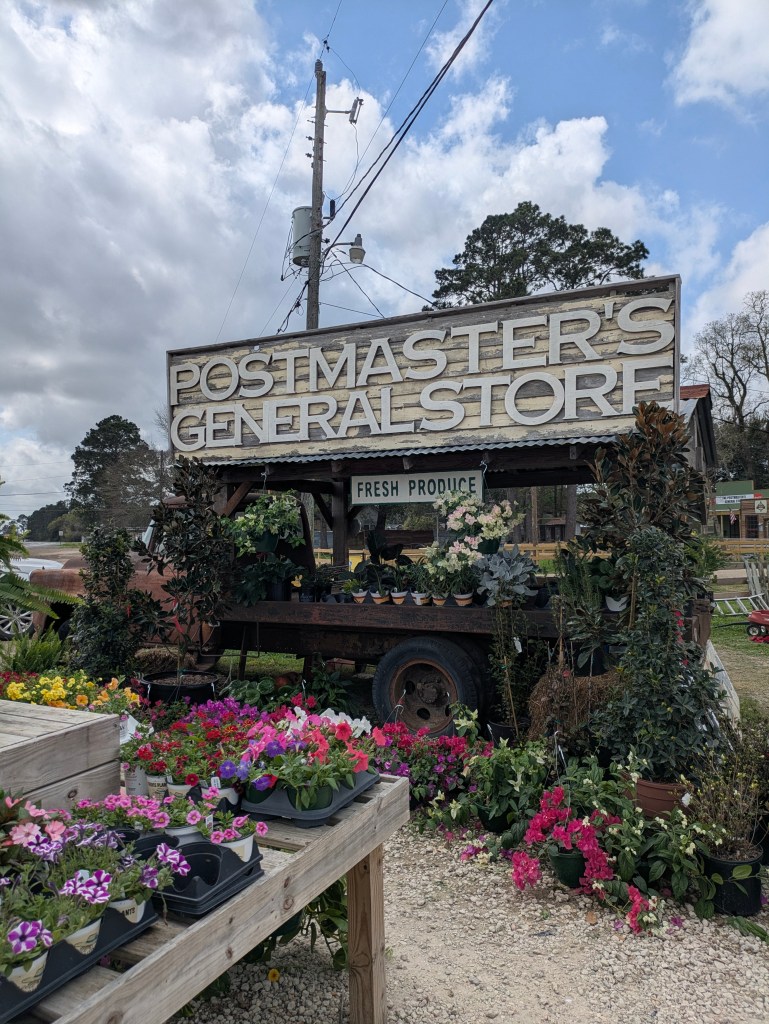
The trend reflects a broader shift in American communities away from national brands and toward local self-reliance. The Postmaster’s General Store, a 1940s-inspired, family-run business off Church Point Highway in Branch, Louisiana, is capitalizing on this movement.
Operating out of a bank-turned-post office, the store specializes in local produce and handcrafted goods. Husband and wife Brock and Blair Stelly opened the business in August 2024. They originally intended to open a restaurant, but when health board requirements for a commercial septic system proved too costly, they pivoted to a mom-and-pop general store.
The shop has since become a staple for area residents, selling everything from raw cow’s milk and holistic products to old-fashioned candies and Cajun-inspired books.
“I think that more people now are trying to get back to their roots, if you will,” Brock Stelly said. “I think people are just trying to slow down and get away from the hustle and bustle of everything that’s going on in life. And our store has a way of slowing people down.”
Friend Susan Lejeune echoed the sentiment, noting she recognized the value of Stelly’s idea early on.
“When he told me his idea of bringing back an old-school feel to a store, I told him it’s a vision from God,” Lejeune said. “You have to go through with it.”
The process wasn’t without hurdles. Stelly laughed as he recalled initially filling empty shelf space with bulk goods from Sam’s Club. Early on, cash flow was tight, and several vendors at local farmers markets rejected their pitches to stock items at the startup store.
As the store grew in popularity, however, the dynamic shifted, and vendors began approaching the Stellys for shelf space.
The store operates primarily on consignment, keeping 35 percent of sales and giving 65 percent back to the vendors. The Stellys occasionally buy goods wholesale if a seller cannot afford to wait for a return on their items, assuming the financial risk in exchange for a higher store profit margin.
For many of the store’s suppliers and customers, the lifestyle choice is driven by a desire for independence and a skepticism toward the ingredients found in mass-produced goods. Many homesteaders prefer to know exactly where their food comes from, relying less on large corporations to feed their families.
While some rely on hubs like the Postmaster’s General Store, others are building self-sufficiency in their own backyards.
Nearly 30 miles away, Kayla and Josh Oliva are working toward establishing a full homestead. For now, they manage a flock of roughly 100 chickens, mill their own grain for bread, and churn butter from locally sourced milk.
The couple originally intended to start with just six chickens, but left the store with nine. Josh quickly became enamored with the birds, and the flock multiplied. Sourcing local materials, they recycled old fencing and the framework of a rundown gazebo to build an array of coops, eventually repurposing the space where their swimming pool used to be.
“We’re baby homesteaders, I guess,” Kayla said.
While the Olivas profit slightly from their chickens and homemade butter, they do not rely entirely on the land for their livelihood. They fall into the category of “hobby farmers”—a smaller-scale, often less expensive entry point into the homesteading lifestyle.
Transitioning to a full-scale homestead requires significant capital. According to a 2016 study by the LSU AgCenter, the basic ranching investment for two acres of land, plus necessary equipment and supplies, can require nearly $130,000 in initial costs.
The LSU AgCenter, a research-based entity within the LSU System, provides agricultural and environmental education across the state. Noting the massive spike in local interest, the AgCenter launched a “Homesteader Newsletter” in the spring of 2025.
Ronald Strahan, a regional director for the AgCenter, said the COVID-19 pandemic sparked his own interest in supplying his family with homegrown produce. The uncertainty of supply chains inspired him to start with potted vegetables in five-gallon buckets. He eventually expanded to a full garden and began canning his harvests.
He is not alone. Over the past three years, the AgCenter’s Homesteader Conference has seen attendance explode from 600 people in its inaugural year to more than 2,000 expected this year.
“There is this interest in being more responsible for your own food,” Strahan said.
 The Cypress Lake Wire
Leave a comment