
By Avery Sturgis
March 22, 2026
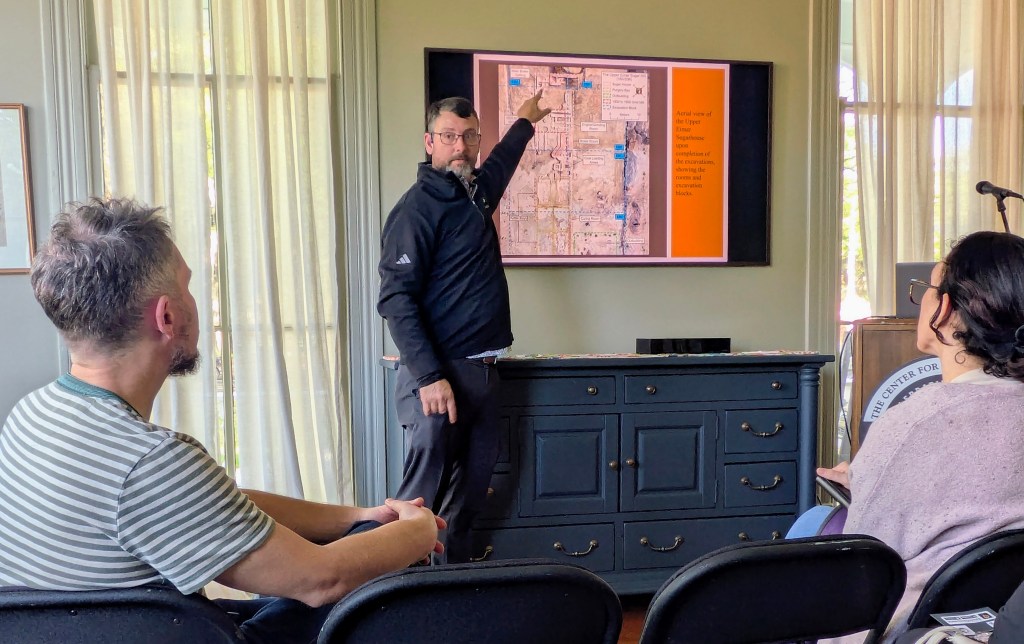
Paul Jackson, Ph.d., an archaeologist with more than 30 years of experience, spoke Thursday, March 19, on the history of Louisiana’s sugar industry.
The event, held at the Roy House at the corner of Johnston Street and University Avenue, was sponsored by the Center for Louisiana Studies at the University of Louisiana at Lafayette.
Joshua Caffery, director of the CLS, said a primary goal of the center is to create academic programming that appeals to the public.
“We’re always looking for people who have interesting topics of various kinds, usually related to Louisiana history or culture,” Caffery said.
Jackson noted that while archaeologists often excel at field work and technical writing, they sometimes struggle to communicate their findings to the general public.
“I’ve always loved that, and that’s the part I wish our field did a better job of,” Jackson said. “Talking to people, you find out way more than you can in the archives. Stories, even oral ones, bring out the backstory. One of the things we try to do in our reports is tell the whole story.”
The Roots of a Global Commodity
Much of Jackson’s current work with Edwards-Pitman Environmental Inc. focuses on cultural resource management, involving excavations of plantations, sugarhouses, and sugar mills across Louisiana.
“We need to understand why sugar,” Jackson said during the presentation. “Few commodities, other than perhaps gold or oil, have affected the world as much as the use of sugar has.”
Since the mid-19th century, Louisiana has played a significant role in the global sugar trade. Jackson explained that during its peak, the state accounted for more than 90% of the nation’s annual production.
While Louisiana’s moist soil made certain cash crops like cotton difficult to grow, it was ideal for sugarcane. Early planters speculated it would be a viable replacement for indigo, which had been devastated by a caterpillar plague that left many farmers in financial ruin.
In 1795, French planter Jean Etienne de Boré and chemist Antoine Morin succeeded in developing a sugar granulation process. The innovation allowed the crop to be transported overseas and launched the Louisiana sugar boom. By 1813, estates began producing sugar via steam—a revolutionary shift from animal-powered sugarhouses.
Why Disasters Yield the Best Artifacts
Jackson said these technological shifts are often visible during excavations, though they present unique challenges.
“This difficulty arises often when new equipment was placed on top of older machinery foundations when the old equipment was removed,” Jackson said. “But based on our previous experience, we anticipate this to be one of the many challenges we face when excavating and interpreting a site.”
Jackson also noted a counterintuitive preference in his field: he prefers sites that have suffered disasters like fires, hurricanes, or war. These events often preserve more artifacts than sites that were simply abandoned.
In disaster-free sites, useful equipment was typically salvaged or sold, and residents often took mementos with them. By the time archaeologists arrive at an abandoned site, often all that remains is “scrap”—broken tools, glass, or a stray teacup.
However, archaeologists use these fragments to piece together the lives of former residents.
Building the Picture with Bricks and Maps
“It all comes back to bricks,” said Dr. Funkhouser, a ULL archaeology professor.
Bricks and mortar are commonly used to map and date a dig site. Because bricks were necessary for building in the soft Louisiana terrain, they remain some of the most durable artifacts. The hardest bricks were typically used for mill foundations, while softer bricks made up the interiors. Samples are often sent to institutions like the University of Alabama for further identification and study.
To locate former sugarhouses, researchers rely on visual field surveys and archived Mississippi River maps. However, these resources aren’t always perfect; decades of coastal erosion have altered the landscape, creating discrepancies between historical records and current terrain.
Connecting the Past to the Living
While researchers also utilize newspapers and business diaries, Jackson emphasized that personal accounts from descendants are invaluable.
Joseph Cilano, a fourth-generation Sicilian-American, attended the talk to learn about his family’s legacy. His great-great-great-grandfather arrived in Louisiana in 1898, recruited by the Sugarcane Association to work on plantations alongside other Italian immigrants.
“I just want to learn a little bit more from an archaeological perspective of what it all entails,” Cilano said.
Many attendees shared similar motivations, connecting their family histories to the industry. For Jackson, this remains the most vital element of the field: connecting the past to the living.
Louisiana remains a leading producer of sugar in the U.S., a legacy built over 230 years. It is an impact, Jackson suggested, that will continue to influence the state’s culture and history for years to come.
 The Cypress Lake Wire
Leave a comment